Why Older Engineers Excel at Agentic Workflows
There's a narrative floating around tech Twitter that older engineers are going to get replaced by AI. That the twenty-three-year-old who grew up with...
There's a narrative floating around tech Twitter that older engineers are going to get replaced by AI. That the twenty-three-year-old who grew up with GitHub Copilot is going to outperform the fifty-two-year-old who started writing C in the early nineties.
I've been that fifty-two-year-old for exactly one year now, and I'm going to push back on this with specifics.
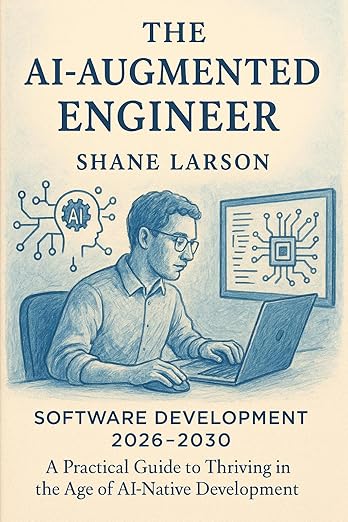
The AI Augmented Engineer: Software Development 2026-2030: A Practical Guide to Thriving in the Age of AI-Native Development
By 2030, 0% of IT work will be done without AI. Data-backed career roadmap for software engineers. No hype, no doom. Practical strategies that work.
Learn MoreThe engineers I see getting the most out of agentic AI tools — Claude Code, Cursor, agentic pipelines that actually ship production code — are overwhelmingly experienced developers. Not junior developers. Not the "AI-native" generation. People with decades of context about how software systems actually behave in the wild.
This isn't an accident. Agentic workflows reward a specific set of skills that take years to develop, and they're skills that no bootcamp or computer science program teaches well.
What Agentic Workflows Actually Require
Let me define terms because "agentic AI" has become one of those phrases people use to mean whatever they want it to mean.
An agentic workflow is one where you give an AI system a goal — not a line of code, not a specific instruction, but a goal — and it figures out the steps. It reads your codebase. It identifies what needs to change. It writes the implementation. It runs the tests. It iterates when something breaks.
This is fundamentally different from autocomplete. Autocomplete suggests the next line. An agentic tool tries to solve the problem.
Here's what that demands from the human in the loop:
The ability to describe what you want precisely. This sounds trivial. It is not. Describing a software requirement clearly enough that another entity can implement it correctly is one of the hardest skills in engineering. Junior developers struggle with this because they often don't know what they don't know. They leave out edge cases, error handling, performance constraints, security considerations — not because they're careless, but because they haven't encountered enough failures to know where the landmines are.
The ability to evaluate the output critically. When Claude Code generates a migration script or a new API endpoint, someone needs to review that code. Not rubber-stamp it. Actually review it. Does it handle the failure modes? Will it perform at scale? Does it interact correctly with the rest of the system? This is pattern recognition built from years of seeing things go wrong.
The ability to debug when the agent gets stuck. Agentic tools are not infallible. They go down wrong paths. They make assumptions that don't hold. They sometimes produce code that passes tests but has subtle correctness issues. Debugging AI-generated code requires the same skills as debugging any code — plus the meta-skill of understanding what the AI was probably trying to do and why it went sideways.
Every single one of these skills improves with experience. Not with youth. With experience.
The Specification Advantage
I've been writing software requirements for three decades. Not formal requirements documents — I mean the practical skill of describing what a piece of software needs to do in enough detail that someone else can build it.
Early in my career, I was terrible at this. I'd describe the happy path and leave out everything else. Then I'd spend days fixing the implementation because I hadn't thought about what happens when the database connection drops, or when the user submits the form twice, or when the input data is in a format nobody anticipated.
Thirty years later, I instinctively think about these things. When I sit down with Claude Code and describe a feature, my prompt naturally includes error handling strategies, performance constraints, security considerations, and edge cases. Not because I'm methodically working through a checklist. Because I've been burned by every single one of these categories enough times that they're automatic.
Here's a real example. Last month I needed to add a job fetcher to one of my projects — a system that pulls job listings from multiple external APIs, classifies them using AI, and stores them in PostgreSQL.
// What a junior might prompt:
// "Write a function that fetches jobs from the RemoteOK API and saves them to the database"

// What I actually described to Claude Code:
// "Build a job fetcher that pulls from RemoteOK, Remotive, and Arbeitnow APIs.
// Handle rate limiting on each API differently — RemoteOK is aggressive about it.
// Deduplicate against existing jobs by external_id before inserting.
// Use batch inserts for performance.
// If one API fails, log the error and continue with the others.
// Track fetch statistics (new, duplicate, failed) and return a summary.
// Add a pre-filter to exclude standard software engineering roles
// before sending to the AI classifier to save on API costs."
That second prompt produces dramatically better code on the first pass. Not because the AI is smarter. Because the specification is better. And the specification is better because I've built enough systems to know where the complexity actually lives.
Pattern Recognition Is the Killer App
There's a concept in chess called pattern recognition. Grandmasters don't calculate more moves ahead than intermediate players. They recognize board positions they've seen before and recall what works. They see patterns, not individual pieces.
Experienced software engineers do the same thing with code. When I look at AI-generated code, I'm not reading it line by line like a compiler. I'm pattern-matching against thirty years of code I've seen succeed and fail.
I can look at a database query and immediately feel that it's going to be slow at scale — before running any benchmarks — because I've seen that shape of query cause problems before. I can look at an error handling pattern and know it's going to swallow exceptions in production because I've debugged that exact failure mode in three previous jobs.
This pattern recognition is exactly what makes code review of AI-generated output effective. The AI can write code that's syntactically correct, passes the tests, and still has structural problems that will surface in production. Catching those problems requires having seen them before.
A junior developer reviewing the same AI-generated code will focus on whether it works. An experienced developer will focus on whether it will keep working. That's a fundamentally different question, and it's the one that matters.
The Debugging Meta-Skill
When an agentic AI tool gets stuck — and they do get stuck — the debugging process is unlike traditional debugging.
Traditional debugging: the code you wrote has a bug. You understand the intent because you wrote it. You trace the logic, find the discrepancy, fix it.
Agentic debugging: the code an AI wrote has a bug. You need to understand what the AI was trying to do, why its approach didn't work, and whether the fix is to patch the existing approach or redirect the AI entirely.
This is closer to debugging someone else's code than debugging your own. And experienced engineers are dramatically better at debugging code they didn't write. Years of maintaining legacy systems, taking over projects mid-stream, doing code reviews on unfamiliar codebases — all of that experience translates directly to working with AI-generated code.
I recently had Claude Code build a content import pipeline that needed to handle markdown conversion, image processing, and CMS integration. The first pass had a subtle issue with how it handled markdown front matter that conflicted with the CMS's expectations. A junior developer might have struggled to even identify where the problem was. I recognized the pattern immediately because I'd hit a nearly identical issue with Contentful's markdown handling two years ago.
The fix took five minutes. Not because I'm smarter. Because I'd been there before.
System-Level Thinking
Here's where age really starts to compound.
Junior developers think about functions and features. Mid-level developers think about modules and services. Senior developers think about systems and their interactions over time.
Agentic workflows operate at the system level. When you ask Claude Code to add a feature to your application, it needs to understand the system: the routing, the data layer, the templates, the middleware, the deployment configuration. The human directing the agent needs to understand all of this at least as well as the AI does — ideally better.
When I'm working with Claude Code on my Express application, I'm thinking about how a new route interacts with the existing middleware stack, whether the new database queries will play nicely with the connection pooling, how the new templates fit into the existing layout hierarchy, and whether the deployment configuration needs to change.
// System-level thinking in action:
// I don't just ask for a new route. I specify the full context.

var express = require('express');
var router = express.Router();
var model = require('../models/jobsModel');

// Rate limiting consideration: admin routes need exemption
// Auth consideration: reuse existing HTTP Basic Auth middleware
// Template consideration: extend template.pug, not standalone
// Database consideration: reuse existing postgres.js pool
// Error consideration: graceful degradation if PostgreSQL is down
This kind of system awareness doesn't come from documentation. It comes from having built, maintained, and debugged enough systems that you intuitively understand how the pieces interact. And it's exactly what makes the difference between an agentic workflow that produces usable code and one that produces isolated fragments that don't fit together.
The Communication Layer
Something nobody talks about: agentic AI workflows are fundamentally a communication exercise.
You're communicating requirements to a system that takes those requirements literally. This is very similar to managing a team of developers — a skill that experienced engineers have usually developed through years of practice.
Every experienced engineering manager has learned the hard way that ambiguous requirements produce ambiguous implementations. That leaving out a constraint doesn't mean it will be inferred — it means it will be ignored. That the gap between what you meant and what you said is where bugs live.
Agentic AI tools have exactly the same property. They do what you tell them, not what you mean. Bridging that gap is a communication skill that takes years to develop.
I've gotten better at prompting Claude Code not because I studied prompt engineering. I got better because I've spent decades learning to communicate technical requirements clearly. The audience changed from human developers to an AI system, but the skill is the same.
Why the "AI-Native" Narrative Is Wrong
The tech industry loves narratives about youth displacing experience. They're almost always wrong in the specifics, even when they're right about the general direction.
Yes, AI is changing software development. Dramatically. But the change doesn't favor youth. It favors the ability to operate at a higher level of abstraction — to think about systems, specify requirements, evaluate output, and debug failures. Every one of those skills correlates with experience, not with age in the negative direction.
The engineers I know who are over forty-five and using agentic tools are not struggling to keep up. They're operating at a level of productivity that wasn't possible before, precisely because the AI handles the parts that were slowing them down (the boilerplate, the syntax lookups, the scaffolding) and they contribute the parts that AI can't replicate (the judgment, the pattern recognition, the system awareness).
I'm shipping more code now, at fifty-two, living in a cabin in Alaska, than I did at thirty-five in a Bay Area office with a team around me. Not because I work more hours. Because agentic tools amplify the skills I spent thirty years developing.
The older engineers aren't the ones who should be worried about AI. They're the ones best positioned to use it.
What This Means Practically
If you're an experienced engineer feeling anxious about AI — stop. Your experience is the asset, not the liability.
If you haven't tried agentic tools yet, start with something like Claude Code on a real project. Not a toy project. A real codebase with real complexity. That's where your experience will shine — when the codebase has history, constraints, and the kind of accumulated complexity that AI needs guidance to navigate.
If you're already using these tools, invest in getting better at specification. The better you describe what you want — including the constraints, edge cases, and failure modes — the better the output. This is a skill you've been developing your entire career. Lean into it.
And if someone tells you that AI is a young person's game, smile and ship your next feature in a quarter of the time it used to take. That's the only argument that matters.
Shane Larson is the founder of Grizzly Peak Software and author of a technical book on training LLMs with Python and PyTorch. He writes code from a cabin in Caswell Lakes, Alaska, where the moose outnumber the software engineers.