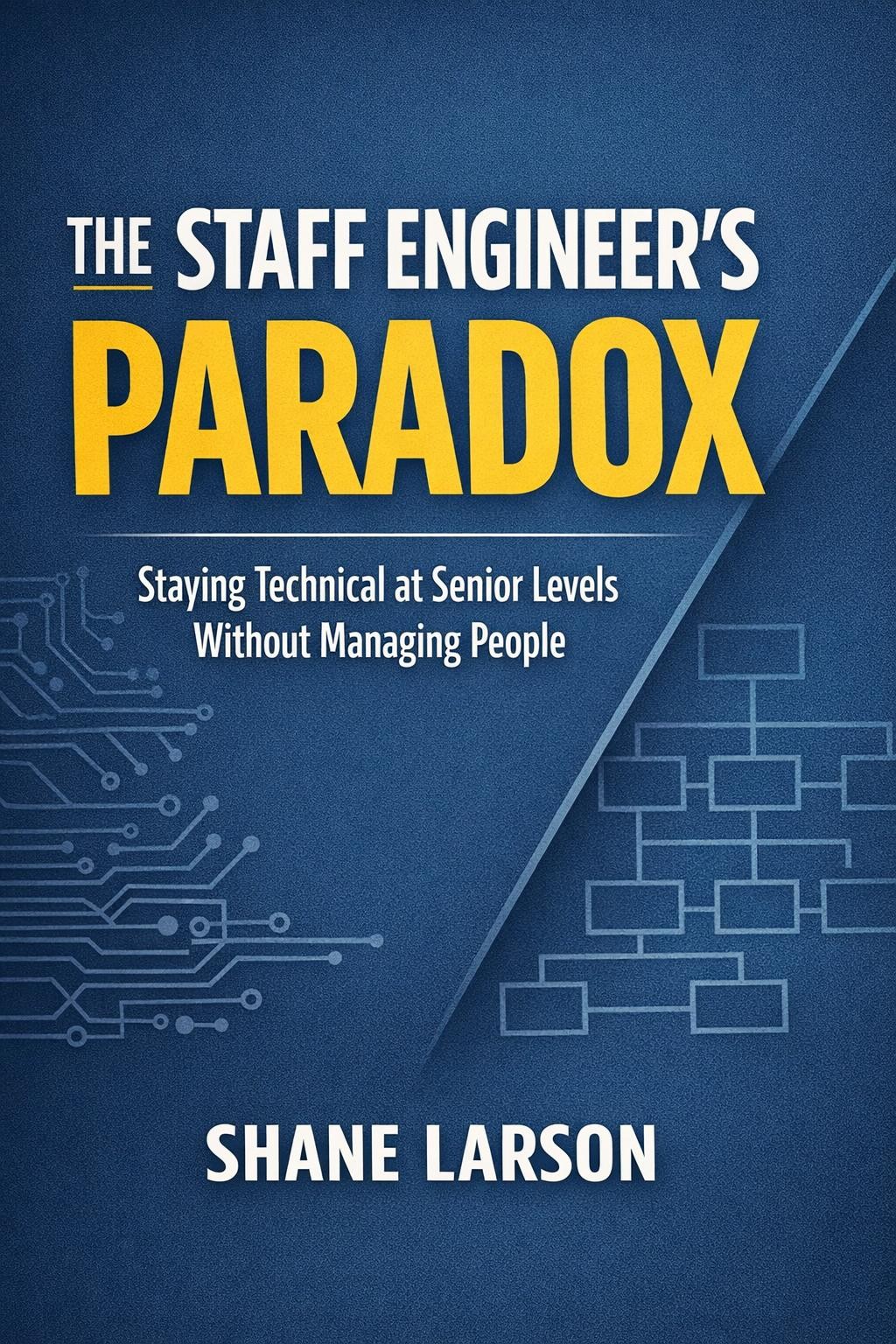
The Staff Engineer's Paradox
Staying Technical at Senior Levels Without Managing People
by Shane Larson
Cross the line into staff engineer and your best work becomes the incident that didn't happen — real, valuable, and invisible unless you learn to make it visible.
You're in an architecture review, and you can see that the design on the screen is going to cause a painful incident about six months from now. You know why. You could name the failure mode, the on-call engineer who'll get paged, and the postmortem that will follow. And you have no ability whatsoever to stop it. You're not this team's manager. You're not their tech lead. You're the staff engineer who was invited to "weigh in," which means you have exactly as much power as the quality of your next sentence. If you convince the room, the disaster doesn't happen. If you don't, it does — and either way, nobody will remember it was you who saw it coming.
This is the job. Not the version in the promotion announcement, and not the inspirational one from conference talks about "technical leadership." The real staff-plus role is a strange, often lonely position where your calendar fills up like a manager's, your influence has to be earned one conversation at a time, and your most important work is precisely the kind that never shows up in a sprint board. You got promoted for being an excellent engineer. Then the definition of the job quietly changed underneath you, and nobody handed you the new one.
The Argument
The core difficulty of staff-plus work is that the thing you're rewarded for is diffuse by nature. As a senior engineer, your impact was legible — you shipped features, you closed tickets, your contributions had your name on them. Cross the line into staff and your best work becomes the incident that didn't happen, the bad architecture that got caught early, the two teams you quietly kept from building the same thing twice. It's real, it's valuable, and it is nearly invisible unless you learn to make it visible. "Good work speaks for itself" is comforting and, at this level, false.
The second difficulty is authority, or the lack of it. "Influence without authority" is the phrase everyone uses and almost nobody explains. It sounds noble until you're the one who has to move a technical decision across three teams that don't report to you and don't have to listen. This book treats that not as a personality trait you either have or don't, but as a set of concrete, learnable moves — how to build the case, when to write it down, who to convince first, and how to disagree without becoming the person meetings route around.
And running underneath all of it is a tension the role never resolves on its own: how technical to stay. Write too much code and you're hoarding work that should be growing other engineers while your strategic responsibilities rot. Write none and you slowly lose the technical judgment that made you worth promoting in the first place. There's a right amount, it's smaller than you'd like, and finding it is one of the central skills of the job.
What's Inside
- Naming the role honestly — the contradictory, frequently confusing day-to-day reality of staff-plus work, stripped of the aspirational fog that surrounds most writing about it.
- Exercising influence when you can't mandate anything: concrete approaches for driving technical outcomes across teams that don't report to you and aren't obligated to agree.
- Calibrating how much code to write, with a practical framework for staying technically grounded without quietly stealing the growth opportunities your engineers need.
- Connecting technical decisions to business outcomes — the difference between architecture and strategy, and how to write a strategy document people actually finish reading.
- Partnering with engineering managers so the split between your job and theirs strengthens the work instead of turning into a turf war.
- Making diffuse, cross-cutting impact legible to the people who decide your trajectory, because work that spans everything shows up nowhere by default.
- Protecting your technical depth when your calendar is actively hostile to deep work, with strategies for staying sharp on stolen time.
- Navigating the long arc — what comes after staff, when staying put is the right call, and when it's time to move.
Why I Wrote This
Most of what's written about staff-plus engineering comes out of a handful of famous Big Tech companies, and it reads that way — aspirational, a little abstract, describing a role with more scaffolding around it than most of us ever get. My own experience of the job was in enterprise settings, where the title shows up without the playbook and you're mostly figuring it out in real time. I spent a lot of years doing exactly that: staying on the technical track, learning the hard way what influence without authority actually requires, watching which of my peers thrived in the ambiguity and which ones drifted back toward management out of sheer confusion about the assignment.
I wrote the guide I wanted when I got there. No fog, no mythology — just an honest account of what the job is and how to do it well, from someone who did it outside the usual glossy context.
Frequently Asked Questions
Is this only relevant if I work at a big tech company?
No — it's deliberately the opposite. Most staff-plus writing assumes a Big Tech environment with heavy support structures. This book is written from enterprise experience, for the far larger number of engineers who hold senior IC titles at ordinary companies and have to define the role themselves.
I'm a senior engineer deciding between staff and management. Will this help me choose?
Yes. A good part of the book is an honest look at what the staff-plus path actually involves day to day, which is exactly the information you need to compare it against the management track rather than choosing based on a job ladder diagram. If you're leaning the other way, the companion volume on moving into management covers that side.
Is it just ideas, or are there things I can actually use?
Both. Alongside the discussion there are practical exercises, ready-to-use templates, and self-assessment tools meant to be applied to your own situation immediately, not admired in the abstract.
Do I need to have been promoted already to get value from it?
No. It's useful whether you're already in a staff, principal, or distinguished role and trying to make sense of it, or you're weighing the path before committing to it. It's also written for managers considering a move back to a senior IC seat.
If You Liked This, You Might Like
- The Accidental Manager — the mirror image of this book, for the fork in the road where you seriously consider leading people instead of staying technical.
- AI and the Leadership Illusion — a sharp argument for why staying close to the technical work is a bet that ages well.
- The Consultant's Leap — for the version of "staying technical" where you take your depth outside the org chart entirely.
- The AI Augmented Engineer — on keeping your technical edge as the craft itself shifts underneath senior engineers.
Stop trying to reverse-engineer your own job description from meeting invites. The role has a shape; this book draws it. Part of the Builder's Career Series.
Get new articles by email
Join the list for new tutorials on API development, AI applications, and software architecture — plus early word on new books. No spam, unsubscribe anytime.
We never share your address. One-click unsubscribe in every email.