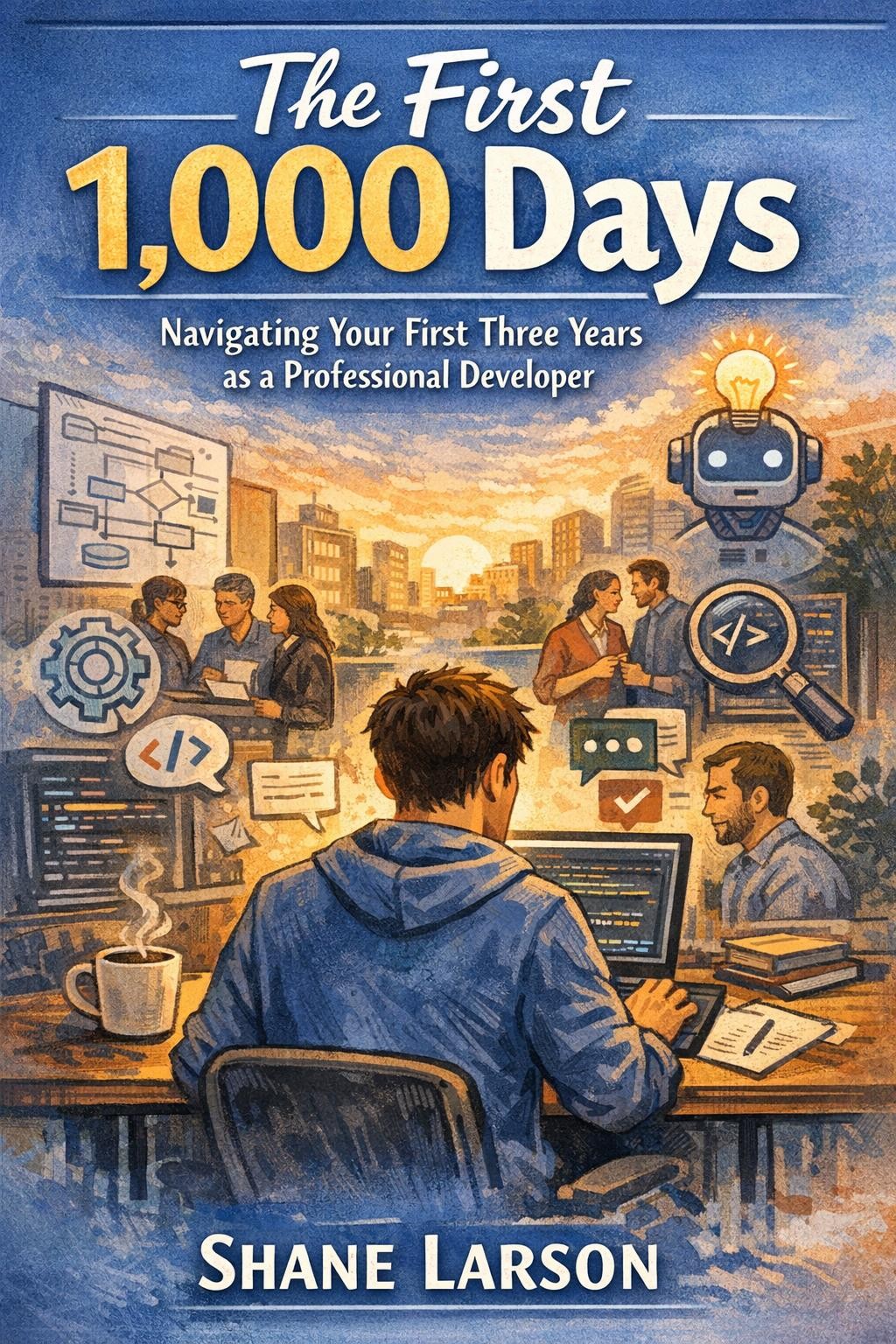
The First 1,000 Days
Navigating Your First Three Years as a Professional Developer
by Shane Larson
School taught you to write code. It did not teach you to inherit code, survive a review, or tell a genuinely hard task from one that's hard only because you're new.
It's your third week. You've been handed your first real ticket — not a "good first issue" with training wheels, but an actual bug affecting actual users. You open the repository and the file tree keeps unfolding: hundreds of directories, a build system nobody mentioned in the interview, three testing frameworks that seem to disagree with each other. Somewhere inside all of it are the thirty lines you need to change. You have no idea where they are. The senior engineer who could point you there has her headphones on, and you've already interrupted her twice today.
That moment — quiet panic wearing the costume of concentration — is where a software career actually begins. Not at graduation. Not when the offer letter lands. It begins the first time you sit in front of a system too large to fit in your head and understand that no one is going to walk you through it. School taught you to write code. It did not teach you to inherit code, to survive a code review, to ask a good question without looking incompetent, or to tell the difference between a task that's genuinely hard and one that's hard only because you're new.
The first three years — roughly a thousand days — are when the shape of your entire career gets set. This is a field guide for walking through them on purpose instead of by accident.
The Argument
Careers in engineering compound. The habits you build in your first thousand days don't stay small; they scale with you. The developer who learns early how to trace a bug methodically instead of staring at it becomes the developer who's trusted with the scary production incident five years later. The one who learns to read a codebase quickly becomes the one who can join any team and be useful in a week. And the one who never builds those habits spends a decade being slower than they should be, wondering why the trajectory never took off.
The problem is that almost every book about engineering careers is written for people who are already past this stage. They assume you know how to navigate an unfamiliar codebase, how to interpret the unwritten rules of a team, how to make a pull request that doesn't annoy the person reviewing it. Those assumptions are exactly the things nobody teaches, and exactly the things that determine whether your early years compound or stall. This book fills that gap deliberately, one skill at a time, in the order you'll actually need them.
It also refuses to pretend the ground hasn't shifted. You are starting your career at the precise moment AI coding tools became standard equipment. That changes what "learning to code well" even means. Leaning on Copilot or Cursor or Claude Code the wrong way in year one can quietly hollow out the fundamentals you most need to build. Used deliberately, the same tools can accelerate you. The difference is not obvious, and getting it right early matters more than almost anything else you'll do.
What's Inside
- Reading an unfamiliar codebase — the single skill that separates developers who ramp up in a week from those who flounder for months, broken into a repeatable process instead of a vague talent.
- Debugging as a discipline rather than a vibe: systematic methods that locate the fault far faster than re-reading the same function hoping it confesses.
- Using AI tools without letting them stunt you — where to lean on them, where leaning on them robs you of the reps that build judgment, and how to tell which is which.
- Surviving code review from both sides: how to open a pull request people actually want to review, and how to give useful feedback while you're still the newest person in the room.
- Decoding team dynamics — the unwritten rules, the trust you have to earn, and how respect is actually granted to a junior engineer (it is not by staying quiet).
- Handling impostor syndrome with strategies grounded in evidence rather than motivational posters, because "just believe in yourself" has never fixed a single anxious Monday.
- Deciding when to specialize and when to stay broad — a framework for the choice that quietly stresses out nearly every early-career developer.
- Understanding what actually drives promotions, and why aiming at them too early in your first thousand days tends to backfire in slow, invisible ways.
Why I Wrote This
I've spent about fifteen years in this industry, most of it as an engineer and then as someone managing and mentoring engineers. I've watched a lot of talented people start their careers, and I kept noticing the same thing: the ones who struggled early weren't less smart. They were missing a small set of unglamorous skills nobody had bothered to teach them, and they thought their struggle meant something about their ability. It didn't.
I also remember being that person — bright enough to get hired, completely unequipped for the first month of actually doing the job. Nobody handed me a map. I wrote the map I wish I'd had. It's the book I'd give a new hire on their first day, and the one I'd give my younger self if the timeline allowed it.
Frequently Asked Questions
Is this book only useful if I studied computer science?
No. It's written for anyone landing their first professional engineering role — CS graduates, bootcamp grads, and career changers alike. If anything, the people who didn't come through a traditional CS program tend to get the most out of it, because it addresses the on-the-job skills that formal programs skip entirely.
I already use Copilot every day. Is the AI material still relevant?
Especially then. Using AI tools constantly is not the same as using them well early in your career. The book's concern isn't whether you use them — it's whether daily use is building your judgment or quietly replacing it before you've developed any. That distinction is hard to see from the inside, which is exactly why it's worth reading about.
Is this a management book?
No. This is about the first three years as an individual contributor — the technical and social skills of being a working developer, not leading one. If you're further along and thinking about the leadership fork in the road, the companion volumes cover those paths.
How does this fit with the rest of the Builder's Career Series?
It's the starting point. The First 1,000 Days covers the beginning; the other books pick up at the decisions that come later — moving into management, staying deeply technical at senior levels, going remote, consulting, or founding a company.
If You Liked This, You Might Like
- The Accidental Manager — for the day, a few years from now, when someone asks you to lead the team you just learned to work on.
- The Remote Builder — because more and more first jobs are remote, and doing your early years well from a home office is its own distinct skill.
- Refactoring Your Career — for thinking past the first thousand days to the longer arc of a sustainable life in tech.
- The AI Augmented Engineer — a fuller look at where AI tooling is taking the craft you're just beginning to learn.
For later chapters of this story, The Staff Engineer's Paradox goes deeper on staying technical at senior levels without moving into management, and a companion volume on the founder path covers the road that leaves the ladder behind entirely.
Get the first thousand days right and you don't just survive them — you turn three years into the foundation the next twenty are built on. Part of the Builder's Career Series.
Get new articles by email
Join the list for new tutorials on API development, AI applications, and software architecture — plus early word on new books. No spam, unsubscribe anytime.
We never share your address. One-click unsubscribe in every email.